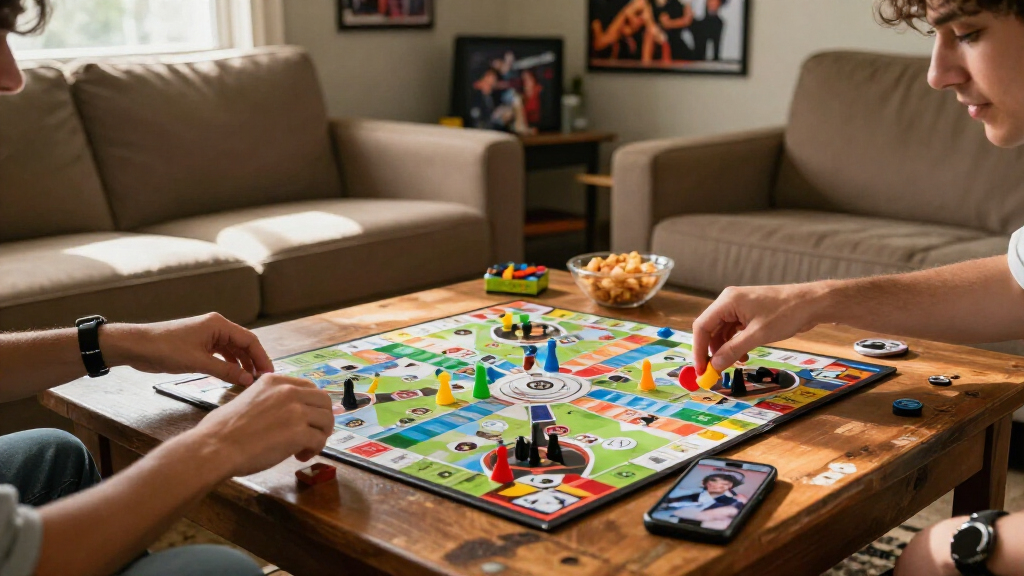

Use this guide to pick a celebrity-themed board game, check that it fits your players, and get a game night ready. It is for anyone hosting friends or family, including people who have not played the chosen game before. Allow 30-60 minutes to compare options and prepare, then set aside the play time listed on the box.

Get movie nights delivered free with Prime
- Fast, free delivery on millions of items
- Prime Video, Amazon Music and more included
- Member-only deals all year

Ridley’s Games Room Celebrity Trivia Card Game
- ✔ Brand: Ridley’s Games Room
- ✔ Players: 2 or more
- ✔ Question cards: 140

Us Weekly: The Star-Studded Party Game
- ✔ Brand: Big Potato
- ✔ Players: 4 or more
- ✔ Recommended age: 14 years and up

Who Says? Friends Trivia Party Game
- ✔ Brand: Asmodee
- ✔ Genre: Trivia
- ✔ Players: 1–4
Difficulty: Beginner | Time: 30-60 minutes, plus game time
What You’ll Need
Tools & Materials:
- A table or other flat playing surface
- The game’s box, components, and instruction booklet
- Paper and pens if the game uses team scoring
- A phone or timer if the rules call for timed turns
Knowledge:
- A rough player count and age range
- Basic familiarity with reading and following a rulebook
Check the box for player count, recommended age, play time, and any expansion requirements. Celebrity names, images, and references may vary by region or edition. If you are buying a game, read recent reviews for comments about outdated references, missing components, or rules that are hard to explain.
Ridley’s Games Room Celebrity Trivia Card Game
For a group that wants celebrity trivia without committing to one show or a high-pressure party format, Ridley’s Games Room Celebrity Trivia is the most versatile choice here. Its 140 multiple-choice questions cover celebrities and pop culture, so players can work from recognition and deduction as well as deep recall. That makes it a more approachable starting point than the open-ended naming rounds in Us Weekly, where quick answers are central to the fun.The card format also gives Ridley’s an easygoing feel: there is no electronic timer to manage, and its sturdy storage box makes the set convenient to bring along. The tradeoff is that it does not provide the same head-to-head urgency as Us Weekly. It also stays firmly within celebrity trivia, which can leave players cold if pop culture is not a shared interest. Compared with Who Says?, it offers wider subject matter but less depth for a group of dedicated fans of one series.We rank it first because it balances recognizable subject matter, simple play, and a two-or-more-player format. It is the safest match for mixed-age family game nights, provided everyone is happy to answer questions about public figures and popular culture.
Pros:
- 140 celebrity and pop-culture question cards
- Multiple-choice play can help less specialized trivia players join in
- Listed for two or more players
- Sturdy box supports storage and portability
Cons:
- Requires at least two players
- The celebrity subject may not interest every group
- Multiple-choice trivia offers less head-to-head pressure than Us Weekly
Best for: Families and mixed-interest groups looking for accessible celebrity and pop-culture trivia for two or more players.
Not ideal for: Players who want a fast team competition, dislike celebrity topics, or prefer trivia tied to a specific show.
Bottom line: We recommend Ridley’s as the best all-around choice when a group wants broad, approachable celebrity trivia without a specialized fandom or electronic timer.
“We recommend Ridley’s as the best all-around choice when a group wants broad, approachable celebrity trivia without a specialized fandom or electronic timer.”
Us Weekly: The Star-Studded Party Game
Where Ridley’s gives players a question and answer choices, Us Weekly: The Star-Studded Party Game asks them to produce celebrity names against the clock. Category cards span actors, musicians, influencers, and other public figures, making the celebrity theme feel more like a lively party prompt than a traditional trivia quiz. The timer and head-to-head rounds add pressure that the card-only Ridley’s game does not emphasize.The components support that more animated format: a gameboard, 180 cards, and an electronic timer create a shared table activity for a group. But the format has a firm boundary: it is designed for four or more players, while Ridley’s can accommodate a smaller gathering and Who Says? is listed for up to four. The timer also requires two AA batteries, an extra setup detail that the other games avoid.We place Us Weekly second because it delivers the strongest party energy for a sufficiently large group, but its minimum player count limits when it can come out. It suits friends who enjoy shouting out names and competing under time pressure. A smaller group, or one that prefers measured question-and-answer turns, will likely find Ridley’s easier to bring to the table.
Pros:
- Celebrity categories cover several kinds of public figures
- Timed head-to-head rounds create lively competition
- Includes a gameboard and 180 cards
- Designed for teen and adult party play
Cons:
- Requires at least four players
- Electronic timer needs two AA batteries
- Open-ended naming rounds may be less accessible than Ridley’s multiple-choice format
Best for: Teen and adult groups of four or more who want quick, competitive celebrity category rounds.
Not ideal for: Smaller groups, players seeking a quiet trivia format, or anyone who does not want to keep AA batteries available.
Bottom line: We would choose Us Weekly for a full party table that wants fast, competitive celebrity challenges and can meet the four-player minimum.
“We would choose Us Weekly for a full party table that wants fast, competitive celebrity challenges and can meet the four-player minimum.”
Who Says? Friends Trivia Party Game
Who Says? Friends Trivia Party Game takes the narrowest approach in this lineup: it asks players to identify who said a quote and whether the line is real or made up. Fans can earn bonus points by naming the season and episode, adding a deeper knowledge layer beyond recognizing familiar dialogue. That makes it more rewarding for show devotees than the broader celebrity prompts in Ridley’s or Us Weekly, but its appeal depends much more heavily on shared interest in one sitcom.The quick-play format includes 100 quote cards and 32 character cards, and the listed playing time is 15 minutes. It is a compact-feeling alternative in concept to the board-and-timer setup of Us Weekly, though its listed dimensions are unusually small and may not tell the whole story of how the cards are packaged. The listed range of one to four players also makes it more flexible for small groups than Us Weekly, while Ridley’s remains the clearer option for general celebrity subject matter.We rank this third as a general celebrity-themed recommendation because the theme is specifically Friends rather than celebrities broadly. For a group that knows the show, that focus is the point: quote recognition and episode details give fans something more tailored to discuss. For casual viewers or larger gatherings, the narrow knowledge base and four-player ceiling make it a less dependable pick than the other two.
Pros:
- Combines quote identification with real-or-made-up challenges
- Bonus points reward deeper season and episode knowledge
- Quick listed playing time of 15 minutes
- Listed for one to four players
Cons:
- Entirely dependent on familiarity with Friends
- Limited to four players, unlike the larger-group format of Us Weekly
- Narrower subject matter than Ridley’s general celebrity trivia
Best for: Friends fans who want a short quote-guessing game with bonus recognition for season and episode knowledge.
Not ideal for: Groups without shared Friends knowledge, larger gatherings, or buyers seeking broad celebrity trivia.
Bottom line: We recommend Who Says? when shared Friends fandom matters more than broad celebrity coverage or accommodating a large party.
“We recommend Who Says? when shared Friends fandom matters more than broad celebrity coverage or accommodating a large party.”
As an Amazon Associate we earn from qualifying purchases.
Before You Start
Choose a game that matches the people who will play, rather than assuming every celebrity theme will suit everyone. Some games rely on trivia knowledge, while others use acting, guessing, wordplay, or pop-culture references. Ask about comfort with performance-based rounds and agree on a respectful tone. Do not use private information, personal photos, or impersonations that target a player without their agreement.
For a gift or event, check that the game is appropriate for the youngest player and that the celebrity references make sense to the group. If the game has mature humor or references, review the cards before inviting younger players.
Step-by-Step Instructions
Step 1: Set the group and game-night limits
Write down how many people will play, their age range, and how much time you have. Note whether the group prefers trivia, teamwork, quick guessing, drawing, acting, or strategy. Decide whether you need a game that works well with an odd number of players or can accommodate people joining late.
Use these details as your selection criteria. For example, a large group may benefit from team turns, while a small group may prefer a game designed for individual play.
Tip: Ask about accessibility needs, such as large print, low reading load, or avoiding timed performance rounds.
Check: You can describe the group size, time limit, preferred play style, and any content or accessibility needs.
Step 2: Compare games against the box details
Check the player count, age rating, listed play time, and game type on each candidate box. Read the description to see what players actually do on a turn. A celebrity theme alone does not tell you whether the game depends on obscure trivia, physical activity, impersonation, or broad pop-culture familiarity.
Compare the printed requirements with your notes from Step 1. If the box says the game is best with more players than you have, look for a two-player variant or choose a different title.
Tip: Treat the play time on the box as a planning estimate. Setup, rule explanation, and breaks can add time.
Check: At least one candidate fits your player count, available time, and group’s preferred style.
Step 3: Check the edition and references
Look at the publication date and edition information. If possible, inspect a sample card list or preview the components. Check that the celebrities and references will be recognizable to your group, especially if players come from different countries or generations.
When buying used, ask the seller to confirm that the rulebook, cards, boards, tokens, and other listed components are present. Compare the contents against the component list in the instructions.
Tip: A newer edition may update references, but it may also change rules or component counts. Check that reviews describe the same edition you plan to buy.
Check: You know which edition you are using and have a reasonable match between its references and the group’s interests.
Step 4: Confirm the game and get the space ready
Choose the game that best fits the group’s needs. Clear a flat surface and make room for the board, cards, player pieces, and scorekeeping. Put out pens, paper, and a timer only if the rules use them.
Count the components against the rulebook before players arrive. Separate decks or tokens as the instructions direct, and keep cards with hidden answers face down.
Tip: If a component is missing, check the box insert and nearby packaging before starting. Do not quietly replace a card or token if that changes how the rules work.
Check: The play area is clear, the required components are present, and hidden information is not visible to other players.
Step 5: Read the rules and choose a first-game format
Read the setup and turn sequence in the instruction booklet. Identify how a player or team wins, how scoring works, and what happens when a player gives an incorrect answer or runs out of time. Check any special rules for ties, skipped turns, or disputed answers.
If the game is long, use an official short-game option if one exists. Avoid inventing a new scoring system before you understand the standard rules.
Tip: Mark or bookmark the pages you expect to consult. Explain unfamiliar terms in plain language before play begins.
Check: You can explain how to set up, take a turn, score, and finish the game using the booklet.
Step 6: Set teams and explain how to play
Assign teams or individual places according to the rules. When teams are allowed, balance them so one team does not hold all the trivia specialists. Tell everyone the goal, turn order, time limit, and scoring method before the first turn.
Run one practice turn if the rules are unfamiliar. Let players ask questions before points count, then begin with the stated first player or team.
Tip: Keep the rulebook nearby. If players disagree about a rule, pause and check the relevant passage instead of making a rushed ruling.
Check: Each player knows whose turn comes next and what earns points.
Step 7: Play fairly and keep the pace comfortable
Follow the turn sequence and use the timer only as the rules specify. Keep answer cards and prompts hidden when required. Do not look up answers or add hints unless the game permits them.
Give players a chance to pass or take a break if a performance prompt makes them uncomfortable. Apply the same rule to every player, and keep jokes focused on the game rather than personal traits or private information.
Tip: For a mixed-age group, explain unfamiliar celebrity references without revealing the answer if the rules allow it.
Check: Turns follow the same rules, scoring is recorded consistently, and everyone can participate comfortably.
Step 8: Finish scoring and put the game away
End the game when the rulebook’s win condition is met. Recount points or tokens if the result is close, then announce the winner. Invite players to confirm that the final score matches the recorded turns.
Sort cards and pieces into their labeled spaces, return the booklet to the box, and note any missing or damaged component before storing the game.
Tip: If you plan to play again, note which rules caused confusion so you can clarify them before the next session.
Check: The winner follows the stated rules, the score is clear, and the components are stored together.
Common Mistakes to Avoid
- Choosing a game only because the celebrity theme sounds appealing. — Check the actual game mechanic and references. Pick a title that suits the group’s knowledge, energy, and comfort with performance or trivia.
- Starting before checking the player count or components. — Compare the box requirements with your group and count components against the booklet before the first turn.
- Explaining rules while play is already underway. — Read the setup, turn sequence, scoring, and win condition first. Use a practice turn when the game is new to the group.
- Changing rules or giving inconsistent hints mid-game. — Use the booklet to settle questions and apply the same rule to every player. Agree on any official variant before starting.
Troubleshooting
Problem: The group does not recognize many of the celebrity names.
Solution: Allow only the hints permitted by the rules and explain references without giving away answers. If recognition remains a barrier, switch to a game with broader references or a different play style.
Problem: A card, token, or other component is missing.
Solution: Check the packaging and compare the contents with the component list. If the game cannot run fairly without the piece, contact the retailer or publisher for a replacement instead of improvising a rule change.
Problem: Players disagree about a correct answer or rule.
Solution: Pause the turn and check the rulebook or the card wording. If the game leaves a question open, agree on one ruling for the whole session and apply it consistently.
Problem: The game is taking longer than the available time.
Solution: Finish the current round and use an official short-game rule for future sessions. Do not change the win condition during play unless everyone agrees and the change is clearly explained.
What Success Looks Like
The group plays a game that fits its size, age range, available time, and preferred style. Players understand the turn sequence and scoring, components are handled as the instructions require, and the final winner can be confirmed from the game’s stated rules.
Next Steps
After the game, ask which rounds the group enjoyed and whether the difficulty or length felt right. Store the components together and replace worn or missing pieces before the next session. If you host another game night, use the feedback to choose a different celebrity theme or a game with a better fit for the group.
Frequently Asked Questions
Can I play a celebrity-themed board game with two people?
Check the box and rulebook for a two-player option. Some games need teams or a larger group to work as intended; use an official variant or choose a title designed for two.
How do I choose a game for players from different age groups?
Check the age recommendation and review the references and humor. Prefer games with clear rules and broad references, and confirm that younger players can take part without needing specialist celebrity knowledge.
What should I do if someone does not want to act out a prompt?
Check whether the rules allow a pass, teammate turn, or alternate prompt. Agree on a comfortable option before play, then use it consistently so no one is pressured to perform.
Can I make my own celebrity cards?
You can create house-rule cards for private play if everyone agrees, but keep them separate from the official deck and explain any rule changes before starting. Avoid prompts based on private information or references that single out a player.