
Choose a gaming laptop, connect the streaming equipment, and run a test broadcast with stable game performance and clear audio. This guide is for beginners who know which games they want to stream and are ready to compare laptop specifications; no streaming setup experience is assumed. Allow 1-2 hours for research, setup, and testing, in addition to any time needed to buy or receive equipment.

Get movie nights delivered free with Prime
- Fast, free delivery on millions of items
- Prime Video, Amazon Music and more included
- Member-only deals all year
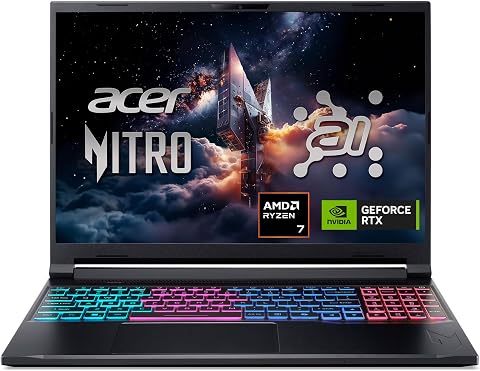
Acer Nitro V 16S AI Gaming Laptop, Ryzen 7 260, RTX 5060, 16-inch WUXGA 180Hz, 32GB RAM, 1TB SSD
- ✔ Processor: AMD Ryzen 7 260
- ✔ Graphics: NVIDIA GeForce RTX 5060 Laptop GPU, 8GB GDDR7
- ✔ Memory: 32GB DDR5 5600 MHz; stated maximum 32GB

ASUS ROG Strix G16 (2025) 16-Inch Gaming Laptop, Intel Core i7-14650HX, NVIDIA GeForce RTX 5060, 16GB DDR5, 1TB PCIe 4.0 SSD
- ✔ Processor: Intel Core i7-14650HX
- ✔ Graphics: NVIDIA GeForce RTX 5060 Laptop GPU, 8GB
- ✔ Memory: 16GB DDR5-5600

Acer Nitro V 15 Gaming Laptop, Intel Core i7-13620H, NVIDIA GeForce RTX 4050, 15.6-inch FHD 165Hz IPS, 16GB DDR5, 1TB SSD
- ✔ Processor: Intel Core i7-13620H
- ✔ Graphics: NVIDIA GeForce RTX 4050 Laptop GPU, 6GB GDDR6
- ✔ Memory: 16GB DDR5; maximum 32GB
Difficulty: Intermediate | Time: 1-2 hours
What You’ll Need
Tools & Materials:
- A shortlist of gaming laptops with current prices and full specifications
- A reliable internet connection; use Ethernet if available
- A headset or microphone, and a webcam if you plan to appear on camera
- Streaming software such as OBS Studio
- A streaming account on the service you plan to use
Knowledge:
- The games and streaming platform you plan to use
- The resolution and frame rate you want viewers to see
- Basic familiarity with installing software and connecting USB devices
Set a spending limit that includes a headset, webcam, or Ethernet adapter if you need them. Laptop prices and specifications change, so compare the exact model configuration for sale. A product family name alone may cover versions with different processors, graphics chips, memory, and screens.
Acer Nitro V 16S AI Gaming Laptop, Ryzen 7 260, RTX 5060, 16-inch WUXGA 180Hz, 32GB RAM, 1TB SSD
The Acer Nitro V 16S AI takes the top spot because it pairs an RTX 5060 with 32GB of DDR5 memory already installed. That matters when we want a game, streaming software, chat, and browser tabs open together without starting from the 16GB configuration found in the Strix G16 and Nitro V 15. Its Ryzen 7 260 processor and 8GB GDDR7 graphics memory round out a current-generation setup, though the supplied details do not establish stream frame rates or encoding outcomes.Its 16-inch WUXGA screen has a 180Hz refresh rate and 100% sRGB coverage. The refresh rate supports fluid local gameplay, while the stated color coverage is useful for content work; neither replaces a proper external preview or stream-quality check. Compared with the Strix, the Nitro V 16S offers twice the installed memory and a slightly faster refresh rate, while the ASUS lists a more elaborate vapor chamber and tri-fan cooling system. The Nitro V 15 is lighter in graphics capability, but offers a more compact 15.6-inch format.At 4.6 pounds, this is the lightest of the listed weights, and its slim design with quad-intake cooling suits people who move their setup. A key limitation is that 32GB is also the stated maximum, leaving no memory headroom beyond the installed capacity. We should choose it when the out-of-box memory configuration matters more than future RAM expansion; buyers planning particularly demanding multitasking should compare upgrade limits carefully.
Pros:
- RTX 5060 Laptop GPU with 8GB GDDR7 graphics memory.
- 32GB DDR5 memory is installed, more than the 16GB in the other two listed configurations.
- 16-inch WUXGA screen has a 180Hz refresh rate and stated 100% sRGB coverage.
- Slim 4.6-pound design, quad-intake cooling, and a second M.2 slot available.
Cons:
- 32GB is the stated maximum memory, so there is no listed RAM expansion beyond the installed amount.
- No battery-life figure is supplied, making mobile broadcast expectations difficult to assess.
- The display is non-touch, which may matter to buyers wanting touch input.
Best for: Streamers who want an RTX 5060 laptop with 32GB RAM installed and a 16-inch, color-capable display.
Not ideal for: Buyers who expect to expand beyond 32GB RAM or prioritize the ASUS’s explicitly detailed vapor chamber and tri-fan cooling design.
Bottom line: We recommend the Nitro V 16S for streamers who want the most complete memory configuration in this lineup alongside RTX 5060 graphics.
“We recommend the Nitro V 16S for streamers who want the most complete memory configuration in this lineup alongside RTX 5060 graphics.”
ASUS ROG Strix G16 (2025) 16-Inch Gaming Laptop, Intel Core i7-14650HX, NVIDIA GeForce RTX 5060, 16GB DDR5, 1TB PCIe 4.0 SSD
For streamers who put sustained gaming and a busy desktop workload first, the ASUS ROG Strix G16 makes a strong case with an Intel Core i7-14650HX and RTX 5060. Its vapor chamber, tri-fan design, and Conductonaut Extreme liquid metal are the most explicitly detailed cooling provisions in this group. That gives us a reason to consider it for longer sessions, although the listed specifications alone cannot confirm temperatures, fan noise, or performance under an actual broadcast workload.Compared with the Nitro V 16S, the Strix starts with 16GB rather than 32GB of RAM, a meaningful difference when several streaming and gaming applications run at once. Tool-free access to RAM and SSD helps if we plan an upgrade, and Wi-Fi 7 is a newer wireless standard than the Wi-Fi 6 listed for both Acer models. Its 16-inch 1920 x 1200 screen runs at 165Hz with a stated 3ms response time, a little below the Nitro V 16S’s 180Hz but still aimed at responsive play.The costs in convenience are physical and power-related: the listed weight is 2.65kg, and the supplied battery-life figure is two hours. We should treat it as a laptop best used near a power outlet, not a dependable all-day mobile stream station. The Nitro V 15 is a smaller alternative with Ethernet and Thunderbolt 4, while the Strix is the better fit for buyers who value its cooling design and straightforward upgrade access.
Pros:
- Intel Core i7-14650HX paired with an RTX 5060 Laptop GPU and 8GB graphics memory.
- Vapor chamber, tri-fan technology, and Conductonaut Extreme liquid metal are specified.
- Tool-free access to RAM and SSD supports straightforward upgrades.
- Wi-Fi 7 and a 16-inch 165Hz display with stated 3ms response time.
Cons:
- Ships with 16GB RAM, half the Nitro V 16S’s installed memory.
- Listed battery life is two hours, limiting unplugged streaming sessions.
- At 2.65kg, it is the heaviest listed option.
Best for: Streamers who want an RTX 5060, a high-performance Intel processor, explicit multi-part cooling, and accessible RAM and SSD upgrades.
Not ideal for: People who need long unplugged sessions, a lighter carry, or 32GB RAM included without upgrading.
Bottom line: Choose the Strix G16 if cooling design and upgrade access matter more to us than low carry weight or a larger starting RAM configuration.
“Choose the Strix G16 if cooling design and upgrade access matter more to us than low carry weight or a larger starting RAM configuration.”
Acer Nitro V 15 Gaming Laptop, Intel Core i7-13620H, NVIDIA GeForce RTX 4050, 15.6-inch FHD 165Hz IPS, 16GB DDR5, 1TB SSD
The Acer Nitro V 15 is the more compact choice in screen size and graphics tier: it pairs a Core i7-13620H with an RTX 4050 and 6GB of GDDR6 graphics memory. That is a step down from the RTX 5060 graphics in the other two laptops, so we rank it third for buyers hoping to play demanding games while broadcasting. Its 16GB RAM and 1TB SSD provide a familiar starting configuration, and the stated 32GB maximum gives us a possible memory upgrade path that the Nitro V 16S does not offer.Where it separates itself is its 15.6-inch matte Full HD display and practical wired ports. The 165Hz panel is suited to responsive local gameplay, while Gigabit Ethernet can provide a direct network connection where a router and cable are available. Thunderbolt 4, HDMI, and four USB ports offer flexibility for capture devices, external storage, and peripherals. Compared with the Strix G16, it weighs 4.7 pounds rather than 2.65kg, though its supplied specifications do not describe an advanced cooling assembly or Wi-Fi 7.This configuration makes the most sense for a streamer who values a smaller screen, a broad port selection, and wired networking more than the extra graphics headroom of an RTX 5060. We should skip it if our priority is running newer, demanding games at higher settings while encoding a stream: the other two have the stronger stated GPU class. The memory ceiling is 32GB, so it can be upgraded from its installed 16GB, but not indefinitely.
Pros:
- 15.6-inch matte Full HD IPS display with a 165Hz refresh rate.
- Gigabit Ethernet supports a wired network connection for a desk setup.
- Thunderbolt 4, HDMI, and four USB ports accommodate streaming peripherals.
- Memory can be expanded from 16GB up to the stated 32GB maximum.
Cons:
- RTX 4050 with 6GB GDDR6 is a lower graphics tier than the RTX 5060 models.
- Starts with 16GB RAM, so heavy multitasking may make an upgrade worth considering.
- Cooling details are not specified as fully as they are for the Strix G16.
Best for: Streamers who prefer a 15.6-inch Full HD laptop, want Gigabit Ethernet and Thunderbolt 4, and can work within RTX 4050 graphics.
Not ideal for: Buyers seeking the strongest graphics option in this comparison or the largest installed memory configuration for multitasking.
Bottom line: The Nitro V 15 is the practical smaller-format pick when wired connectivity and ports matter more than RTX 5060-class graphics headroom.
“The Nitro V 15 is the practical smaller-format pick when wired connectivity and ports matter more than RTX 5060-class graphics headroom.”
As an Amazon Associate we earn from qualifying purchases.
Before You Start
Streaming runs a game, video encoding, and background software at the same time. Laptop performance depends on the complete configuration and cooling, not a single specification. Decide on a realistic starting target: 1080p at 30 frames per second is a manageable first stream for many setups. A faster frame rate or more demanding game may call for stronger hardware and more upload bandwidth. Confirm the streaming service’s current broadcast settings before you buy or configure the laptop.
Step-by-Step Instructions
Step 1: Set your stream target
Write down the most demanding game you intend to stream, the stream resolution, and the frame rate. If you are unsure, start with 1080p at 30 frames per second. Note whether you will stream from the same laptop while gaming, use a webcam, or connect capture equipment.
Check the platform’s current requirements for supported resolution, frame rate, and bitrate. These limits affect what the laptop and connection need to deliver.
Tip: A stream can look smooth at a lower resolution even when the game runs at a higher resolution on your own screen. You do not need to stream at the laptop display’s maximum resolution.
Check: You have a written target for the game, stream resolution, frame rate, and any video or audio devices.
Step 2: Check your upload connection
Run an internet speed test from the room where you will stream. Record the upload result, then repeat the test at a different time if your connection varies. Compare the results with the platform’s recommended bitrate for your target quality.
Leave headroom above the stream bitrate for connection changes and other devices using your network. If possible, plan to connect the laptop to your router with Ethernet. A speed test shows a moment in time; it does not guarantee that a wireless connection will stay steady during a broadcast.
Tip: Do not choose a bitrate based only on download speed. Streaming sends video from your home, so upload speed and stability matter.
Check: Your upload speed is consistently higher than the bitrate you plan to use, with room for normal variation.
Step 3: Compare the processor and graphics chip
Compare complete laptop configurations that meet your target in the games you play. Look for independent reviews that test the same processor and graphics chip combination, since laptop power limits and cooling affect performance. Check whether the graphics chip has a hardware video encoder supported by your streaming software; hardware encoding can reduce the work done by the processor while a game is running.
Pay attention to sustained gaming and streaming results, fan noise, and temperatures, not only short benchmark peaks. A thin laptop may be easier to carry but can have less room to cool its components.
Tip: Compare reviews of the exact graphics configuration. A mobile graphics chip with the same name can perform differently across laptop designs because manufacturers set different power limits.
Check: You have at least two candidate laptops with reviews that cover gaming performance, cooling, and streaming or encoding.
Step 4: Check memory, storage, and display
Check the installed memory and whether it can be upgraded. For gaming and streaming together, 16 GB is a practical starting point; 32 GB gives more room for demanding games and background apps. Confirm how many memory slots are available and whether the memory is soldered before relying on a later upgrade.
Check storage capacity for your games, recordings, and software. Look at the display size and refresh rate for your own play, while treating those as separate from stream quality. Verify that the laptop has enough usable USB ports for your microphone, webcam, headset receiver, and other equipment.
Tip: Some laptops advertise a large drive or memory capacity only on higher-priced configurations. Confirm the specifications of the exact item in your cart.
Check: The chosen configuration has enough memory and storage for your use, a suitable screen, and ports for your planned devices.
Step 5: Confirm cooling, power, and connectivity
Read reviews for fan noise during long gaming sessions and check that the laptop maintains performance while plugged in. Confirm that the included power adapter is suitable for full performance. Look for Ethernet or a compatible adapter, stable Wi-Fi, and the USB ports required by your equipment. If you plan to use an external monitor, verify the video output type and supported display capability.
Check the laptop’s return policy and warranty before purchase. A short return window gives you time to test the actual system with your game and stream software.
Tip: Gaming laptops often run fans audibly under load. If your microphone picks up fan noise, plan to position it close to your mouth and away from the laptop exhaust.
Check: You have confirmed the connection options, power setup, cooling behavior, and return terms for the specific laptop.
Step 6: Install updates and connect your gear
Place the laptop on a firm, flat surface with clear space around its vents. Connect the power adapter and Ethernet cable if available. Install system updates, graphics drivers, your game, and streaming software. Restart if an update requests it.
Connect the microphone or headset and webcam, then select them as the input devices in the operating system and streaming software. Put the microphone close enough to capture your voice without pointing it at a fan or speaker.
Tip: Avoid gaming on a bed, cushion, or soft surface that can block the laptop’s intake vents.
Check: The laptop recognizes each connected device, the software opens, and the vents remain unobstructed.
Step 7: Configure and test a private stream
In OBS Studio or your chosen software, select the game’s capture source, microphone, webcam if used, and the streaming service. Choose a hardware encoder if the software offers one and the laptop supports it. Set the resolution, frame rate, and bitrate to values supported by both your connection and the service.
Make a local recording or use a private test mode before broadcasting publicly. Play the most demanding section of your game for at least 15 minutes while watching the software’s dropped-frame and rendering indicators. Listen to the recording with headphones. Adjust the bitrate or stream resolution if the network drops frames; lower game settings or the stream frame rate if the laptop struggles to render or encode.
Tip: Change one setting at a time and repeat the same test section. That makes it easier to identify which change fixed a problem.
Check: The test has stable game play, no persistent dropped frames, clear voice audio, and a readable image at your chosen stream settings.
Common Mistakes to Avoid
- Buying by graphics chip name alone. — Check reviews for the exact laptop configuration, including sustained performance, power limits, and cooling.
- Assuming fast download speed means the stream connection is ready. — Test upload speed and stability where you will play, and leave headroom above the planned bitrate.
- Choosing a stream resolution or frame rate before checking the laptop and platform. — Start with a moderate target, check platform limits, then raise quality only after a test broadcast performs well.
- Blocking the laptop vents or placing the microphone beside the exhaust. — Use a firm surface with clear airflow and position the microphone near your mouth, away from fans.
Troubleshooting
Problem: The stream drops frames while the game looks smooth.
Solution:
Check whether the software reports network or rendering drops. For network drops, lower the bitrate, use Ethernet, or reduce other network traffic. For rendering drops, lower the game’s graphics settings or the stream frame rate and test again.
Problem: The game stutters when streaming starts.
Solution:
Plug in the power adapter, close unneeded background apps, and check that the software uses the hardware encoder when available. Reduce demanding game settings or the stream resolution, then repeat the same test scene.
Problem: Viewers hear fan noise or echo.
Solution:
Move the microphone closer to your mouth and away from the laptop vents. Use headphones instead of speakers to prevent game audio from returning through the microphone. Adjust input sensitivity and make another recording.
Problem: The webcam or microphone does not appear in the streaming software.
Solution:
Reconnect the device, try another USB port, and check operating system privacy permissions. Confirm that another app is not holding the device, then select it again in the software’s audio or video source settings.
What Success Looks Like
Your setup is ready when the laptop runs your chosen game while a test stream or recording holds the target resolution and frame rate without persistent dropped frames. Your voice is clear, the game audio is balanced, the camera image is usable if enabled, and the laptop remains on a firm surface with open vents. The platform’s test or status indicator should show a stable connection.
Next Steps
Save the settings that passed your test and make a short private test before your first public broadcast. Recheck the connection and audio whenever you change rooms, networks, microphones, or major software versions. If performance declines, review dropped-frame statistics and temperatures before changing several settings at once.
Frequently Asked Questions
Is 16 GB of memory enough for gaming and streaming?
It can be a practical starting point for many games and a basic streaming setup. Demanding games, browsers, overlays, and editing software can use more memory, so 32 GB offers extra room. Check whether the laptop’s memory can be upgraded.
Do I need a separate streaming PC?
No. Many gaming laptops can run a game and stream from one system, especially when using a supported hardware encoder. A second PC can help with specialized setups, but it adds cost and equipment. Test your target game and stream quality on one laptop first.
Can I stream over Wi-Fi?
Yes, if the connection is stable and has enough upload capacity. Ethernet usually reduces interruptions and variation. If you use Wi-Fi, test from the exact location and during the hours you plan to stream.
Should I stream at 1080p and 60 frames per second?
Choose that target only if your laptop, upload connection, and streaming service support it reliably. Start at 1080p and 30 frames per second if you are unsure, then test higher settings while monitoring dropped frames and game performance.